Friday, May 29, 2015

Ottoman Literature Class Handout

I finally finished putting together a lot of my research in the form of a class I will be teaching at a symposium tomorrow. There are generalizations and vague lists here that won't make as much sense without the benefit of taking the class in person. The language of the terminology sometimes waffles between Arabic, Persian and Turkish. This in not nearly the extent of my research! It is here as a starting point for those interested or if I run out of handouts. 

Ottoman Literature and Storytelling
Lady Eilon bat Miriam.   Mka: D. Brianne Galgano.
  Eilon.bat.miriam@gmail.com  

Where to Draw Inspiration

The Ottoman Empire spanned or traded with the greater part of what we often refer to as the Middle East.  As a result of their political dealings and expansions there are a fair amount of cultures that we identify separately, from a historical point of view, that are actually considered Ottoman in period, and it is well documented that the Ottomans borrowed heavily from them. The Persians(in part), Greeks, and Byzantines all became part of the empire and, even the origin of the Osman's Empire was built with the help of Mongolians.  So, generally speaking, you have  lot of cultures, Eastern and Arabic, to choose from for stories.  In this document I have tried to focus  on what I feel best captures the Ottoman spirit of story creation here. Strictly speaking, the Ottoman Empire started in 1299 and continued into the 20th century. You may choose, however,  to tell stories outside of that time. The last Crusade was only 30 years before the inception of the empire and there is evidence of 8th Century stories of varying Arabic cultures being collected rewritten by a 16th century sultan. In other words: use good judgment and follow these guidelines when choosing your story base. 


The Art of the Oral Tale

Storytelling was a well utilized form of entertainment and moral education in the Ottoman empire but was not nearly as respected as poetry. Documenting an oral tradition is difficult. Much of what has been written about it is modern but well researched. There are plenty of things written about the storytellers but much less about how they told stories in period. My research has led me to a storytelling voice that creates an Ottoman performance from other cultures' tales.  One view of many of the recorded stories in period is that they were meant to be read aloud. Translations can be problematic in that the translator might not share this view and that voice is lost. You may need to recreate that voice in your chosen tale.

Story Types

·         Fikra - Short anecdotes that are comical, informative, chastising, or serve as a rebuttal. Specialized forms of fikra include: nükete (pun) and kissa (moralistic fable, realistic).
·         Hikaye and Masal - Entertaining short stories more for the sake of enjoyment, and  Fables with fantastical elements such as talking animals.
·         Efsane and Destan - Legends, myths and epics. Ex: Shanamah, Dede Korkut, Sinbad, Gilgamesh, and the Odyssey.

Storytelling Elements

·         Tekerleme - The opening lines of a story,  It is a miniature poem with a rhyme or meter. Sometimes it will have an element of the absurd or at the very least something to make the story timeless. Perhaps the final line hints at the moral of the story. The most iconic tekerleme component is a variant of: "Once there was; once there wasn't..."  Not used as much for Fikra.

·         Closing - May recap the moral of the tale. "Three apples fell from the sky, one for the teller of the tale, one for the listener, and one for whoever will pass the tale along." "They had their wish fulfilled; let us go up and sit in their seats" (Walker 2). "This was his tale."

·         Auspicious numbers like  Three, Seven, and Forty.  Weddings were celebrated for forty days and nights. Thieves, slaves, soldiers, wise men, came in groups of forty. Three apples, hairs, flowers, seeds, pieces of instruction. Three or Seven brothers, sisters, wives.

·         Ambiguous Time - "went a little; he went far. He traveled straight over hills and over dales. He traveled six months and a summer, [...] She went for months and years, and she became very tired" (Walker 1).

·         Verbal Elements: Onomatopoeia, Repetition (Cliché) , Alliteration, and Chanting.

·         Religious Elements -  Islamic practices, Praise of Allah at his mention, offering the blessing of Allah to gain favor, Morality, ablutions, and Obedience.

·         Cultural Reminders - Sumptuary laws, Values, Social and family customs, and Historical figures.

·         Metaphors and Similes -  Culturally relevant. Aesthetic of beauty: The moon, Black hair and fair skin. "With scarcely wit enough to salt one dolma" (Walker 1).

·         Aja-ib - The Marvelous and Fantastical: Flying horses, sea beasts, magic, Ifrit, Djinn, etc. Historical and religious tales are told as legends.


Plot Devices & Themes
  •          Journey - to Mecca, to follow a dream, to find what you wanted was back home.
  •          Changing Fate - How the common man becomes someone great by a very simple action or vice-versa.  Becoming the perceptions of one's destiny, like following in the footsteps of the father or being great because no informed you otherwise.
  •          Dreams of wealth - extravagant retellings of desires only to be distracted by them.
  •          Prophecy - often made by astrologers, almost always come true. Sometimes made by clever people who are extremely perceptive.
  •          Testing Virtues: loyalty, charity, honesty, etc. Competitions, Tasks, and Challenges.
  •          Wagers - a way around the ills of coveting or the impolite of asking to purchase something.
  •          Deceitful People - women, schemers, cheats, liars, ungrateful betrayers.
  •          Romantic Complications - bride swaps, many brothers, ugly women vs. pretty, men so sick with love it ruins them, trickster mothers, already married.   
  •  Secret Knowledge - magic powers that kill you if revealed, spying to use for ill/gain, confusion/misunderstanding by eavesdropper. 
  • Almost every story sees a happy resolution. Plots are almost always singular.


Characters

  •          Wise Man/ Hodja - Preachers (Imam), Teachers, Judges (Kadi), Nasreddin.
  •          Rulers - Sultan, Padishah (Shah), Caliph, Bey, Ağa, Conquerors (Tamerlane). They are often arrogant or afraid to admit their mistakes. They will assign tasks or quests. Used as a device to allow the disenfranchised to prove themselves clever or worthy.
  •          The Hero  -Stories are often like epics or contain a fair amount of the fantastical. Ex: Iskendar (Alexander the Great), Hanzal, Köroğlu and  Kirat (his flying horse), Rüstem, Dede Korkut.
  •          The Wag/Jester/Trickster-  Clever or scheming character. Stories involve tricks and lessons, luck, and often irony. Ex: Keloğlan, Aldar, Nasreddin.
  •          Disenfranchised - Your weak, poor, common, or uneducated souls that make better of themselves or are duped. Sometimes these characters are in a trickster (Wag) role. Ex. Keloğlan - bald, uneducated or sometimes diseased;  used as a noun. 
  •          Karagöz  and Hacivat -  Comedic look at the common man vs. educated; most noted as the main characters in shadow plays. Stories were often chosen with the idea that by using puppets the storytellers could deviate from social norms. 


Glossary of Useful Words and Phrases

·         Wag - Someone who makes inappropriate humor, flippant, smartass. 1550: probably from 'waghalter, ‘ a person likely to be hanged (Dictionary.com)
·         Bismillah - "In the Name of Allah."
·         Inşallah - " If Allah wills it."
·         Göstermesin - "Allah forbid!"
·         Cüş - Whoa
·         Eyvah - Alas!
·         Öf! - Ugh
·         Selậmünaleyküm - "Peace be with you," and Aleykümselậm - "Peace to you too."
·         Effendi - term of respect added to the end of someone's name when addressing them.
·         Hanim - respectful title for a woman; "lady."
·         Herrop! - Hurrah or Vivat
·         Fikra Malum - phrase used to introduce a familiar anecdote instead of the tekerleme.

Some Notes About Research

The overall culture in the three hundred years we view it in society contains very little that changes drastically.  The Arabic calendar is about six hundred years earlier than our own so double check your dates. Translations to English are always subject to the view of the translator. Some translators are coming from the outside and miss the bigger picture. Some translators keep the original Islamic context and make a direct translation, others try to capture the voice and the meter, some only seek to make a piece accessible to a Western audience.  Ultimately, you can create your own stories about the characters or people you know in the style by using the devices and techniques outlined here and using the Ottoman voice.

Annotated Bibliography

Adler, Cyrus. Told in the Coffee House: Turkish Tales. Filiquarian Publishing, LLC. /Qontro.
               Original Publishing: Collected and Done into English by Cyrus Adler and Allan Ramsay. The Macmillan Company, London. 1898. I believe this is an OCR copy that interestingly includes book adds for 1898. Authors spent time in coffee houses listening to the oral literature in Constantinople that he believes were not previously put to paper.

Adler, Elkan Nathan Ed. Jewish Travelers in the Middle Ages: 19 Firsthand Accounts.
                English translations of Jewish traveler accounts. The Journal of David Reubeni  has him travel from Ethiopia through parts of the Ottoman Empire on his way to Rome between 1522 and 1525.

Dulcken, H.W. Editor. Tales of the Arabian Nights. Castle Books. New York, NY. 1984
                Transcription information unknown. Useful as starting place for stories.  These stories' origins are from period sources (Ex. The Thousand and One Nights) but, were most likely modernized in the 1800's. Be mindful of cultural anachronisms in SCA retellings.

Faroqhi, Suraiya and Arzu Ozturkmen, Editors. Celebration, Entertainment and Theatre in the Ottoman World. Seagull Books, London. 2014.

                Many scholarly articles on the subjects listed in the title. A lot of the information is post 1600. I would assert that anything up to 1650 is fair game based on cultural cycles and sultanate of     the time. Ottoman history and culture didn't move at the same rate as Europe and it is hard to             compare it in terms of historical re-creation.

Gabrieli, Francesco. Arab Historians of the Crusades. University of California Press,  Los Angeles. 1984.
                Translations of Crusade era Arabic writers and historians. Includes many notes and a      biographical section for each of the authors. Names some of the writers' other (often more       literary) works.

Ghiselin, Ogier de Busbecq. Translated by Edward Seymour Forster. The Turkish Letters of Ogier Ghiselin de Busbecq. Louisiana State University Press. Baton Rough, LA. 2008.
                [Primary]Imperial Ambassador at Constantinople to Frederick 1554-1562. Translated from the Latin of the Elzevir Edition of 1633 by Edward Seymour Forster, 1927. Contains an immense       amount of cultural and political information from a primary view. Discusses the telling of tales at       the caravan serai. I constantly draw from this source as inspiration and for appropriate usage of      culture or item in poems and stories.

Halman, Talat S. A Millennium of Turkish Literature: A Concise History.  Syracuse University Press. Syracuse, NY 2011.
                Contains a fair amount of information on structure and cultural importance. Better as a source for poetry but discusses an overview of the literature, much of which is very post period.
Kwiatkowski, Will. The Eckstein Shahnama: An Ottoman Book of Kings. Study of an 11th C. Persian Manuscript rewritten for the Ottoman Court (16th C.) Contains one of the many tellings of the adventures of Iskendar (Alexander the Great).  

Lowry, Glen D. with Susan Nemazee. A Jeweler's Eye: Islamic Arts of the Book from the Vever Collection. The Sackler Gallery: Smithsonian Institution. University of Washington Press, Seattle and London. 1988.
                An excellent collection of Ottoman, Persian, and Mughal miniatures with descriptions of the stories they are illustrating.  

Lyons, C. Malcolm: Translator. Tales of the Marvelous and News of the Strange: The First English Translation of a Medieval Arab Fantasy Collection. Penguin Classics, London. 2014.
                Has excellent descriptions of story archetypes and mechanisms.

Tichy, Jaroslav. Legends From Eastern Lands. Paul Hamlyn, London. Translated by Alice Denesova. 1967.
                Folk tales from the area surrounding the Black and Caspian Seas. Trade routes through these lands brought stories from faraway lands. Historically, 13th C. dictator, Tamerlane was a fear of the peoples surrounding the Southern Steppes and it is evident that those such as "Nasreddin"           are present in their culture as a result.

Walker, Barbara K. The Art of the Turkish Tale: Volume 1. Texas Tech University Press, Texas. 1990.
                Extensive recordings were done of modern (1960-70's) storytellers that have carried on the oral tradition of many tales that may date back to Early Ottoman times. Contains excellent analysis   of character archetype and oral forms.

Walker, Barbara K. The Art of the Turkish Tale: Volume 2. Texas Tech University Press, Texas. 1990.
                Continuing the translation of stories, the author includes further insight into the preservation process and the overall importance still of the oral tradition of tales.


Sunday, April 12, 2015

Ghazel

I am working on writing two classes for an upcoming Atlantian event in May called Cooks and Performers. I am working on Ottoman poetry and Ottoman storytelling classes, specifically. I was re-checking all the things I needed to run the arts and sciences for our Spring Coronation and saw the Poeta Atlantia competition, to decide the royal poet, would be there. Then I thought about how I'd been absent from writing for a few years now. Next I thought about how no one in this kingdom knows that I'm a writer...because I haven't really written anything since I got here. Finally, I realized that I should probably put something out there so people know I have a leg to stand on when I teach about these things. 

So, I entered the requisite two pieces. I was approached by several people that they loved my first piece, especially. I was also told that I was just a smidgen away from winning the competition. Here is the second piece that entered. It was requested that we write something in honor of their Majesties being crowned that day. I decided to do a Ghazel. It was the easiest Ottoman form that judges could look up if they were unfamiliar with...which I assumed they would be. 

Coronation Ghazel for Logan and Esa
                        Lady Eilon bat Miriam, MKA Brianne Galgano
                                                        Coronation A.S. XLIX

Tremble this day of Spring that brings with it the Might of Atlantia.
Revel  in the warmth and magic that flows from the Majesty of Atlantia.
Banners with wind do stream behind the parades of those who gather.
A promise once made,  finally fulfilled,  to return to the thrones of Atlantia.
Fierce and Tempered; For so kind and gentle a leader in he you'd not expect.
Watch how he trains our young combatants; he's earned the grace due Atlantia.
Beautiful and graceful she; For so powerful and strong you'd not presume.
Behold the inspiration she leaves in her wake;  she is a mother to Atlantia.
Tarry not, this day of Spring, we await the new crowns to claim their seat.
Humble am I, Eilon, to be present to share in the glory of their reign over Atlantia.


The Documentation I submitted for the competition:

This poem,  in honor of their Majesties,  is in the form of an Ottoman Ghazel.
In short, Ghazels consist of 5 - 15 couplets with a rhyming structure of:  aa/ba/ca/da/ea.  
The initial couplet, the matla, should rhyme.  The end of each couplet thereafter should rhyme the matla. The final line, the maqta,  should act as the conclusion or point of the piece. The poet's name is sometimes part of the maqta as a signature/title. Redd-i matla is another way of ending the poem where the poet repeats one of the matla directly for a bookend effect.

Exemplar  - Baqi (1526-1600) "Dil derd-i 'ishq-i yar ile bezm-i belada dir," Ghazel:

                All sick the heart with love for her, sad at the feast of woe;
                Bent form, the harp; low wail, the flute; heart's blood for with doth flow.
                Prone lies the frame her path's dust 'neath, in union's stream the eye.
                In air the mind, the soul 'midst separation's fiery glow.
                O ever shall it be my lot, zone-like, thy waist to clasp!
                'Twixt us, O love, the dagger-blade of severance doth show!
                Thou art the Queen of earth, thy cheeks are Towers of might, this day
                Before thy Horse, like Pawns, the Kings of grace and beauty go.
                Him hinder not, beside thee let him creep, o Shade-like stay!
                Baqi, thy servant, O my Queen, before thee lieth low.

As this poem was to commemorate their Majesties coronation, the best rhyme to use ended up being directly, "Atlantia." 


Ottoman Poetry Annotated Bibliography

Gibb, Elias John Wilkinson. A History of Ottoman Poetry Volume 1. University of Michigan.

  • Digital Copy provided by google books. Original printing Luzac & Co., London. 1900. https://play.google.com/books/reader?id=FStkAAAAMAAJ&printsec=frontcover&output=reader         &authuser=0&hl=en&pg=GBS.PA51. 5 October 2014.


Gibb, Elias John Wilkinson. Ottoman Literature: The Poets and Poetry of Turkey.  2012.

  • Forgotten Books Facsimile Reprint: M. Walter Dunne, Publisher, London.  1901. "Translated from the Arabic with introductions and biographical notes by the author. With Arabian, Persian and Hebrew poems and special Introduction by Theodore P. Ion, J.D. " Contains many pre 17th century poetry examples.

Halman, Talat S. A Millennium of Turkish Literature: A Concise History.  Syracuse University Press. Syracuse, NY 2011.

  • Contains a fair amount of information on structure and cultural importance. Not  many examples but, does offer comparative examples to other translated versions of poems in other sources.

Lewis, Bernard. Music of a Distant Drum: Classical Arabic, Persian, Turkish & Hebrew Poems.
Princeton University Press. Princeton, NJ. 2001.
  • Translation by author. Includes mini biographies of poets, and brief discussion of poetry structures and cultural importance. 


My Thoughts post competition:

This is not the best example of a Ghazel. I had certain parameters I needed to follow and a short period of time (my fault entirely). I found an example piece that barely touched on the idea of praising a monarch. In this case it is more that Baqi is professing his idealized and most likely unrequited love for a lady of nobility or otherwise someone he cannot attain. I found another piece that was actually very much in praise and honor of a noble but, sadly, it was post period. 

In terms of rhymes it is uninspired. It really is just one more "Rah, Kingdom,"  "Praise their Majesties," kind of poem. I don't often find them original or inspiring to begin with so, I suppose I am biased that way. I did find a small personal observation on each of their majesties that I utilized. I am proud of this poem only because it made it personal. That is the best thing about poetry, to me. You can analyze all you want, but it's true meaning is always the author's little secret; specifically chosen words for reasons the reader may never comprehend. A reader/listener is going to associate the words and sounds their own way, comparing it to their own experience. If it touches the audience in any way the author has succeeded. 

I have several ghazels and other Ottoman poetry in varying stages of done. When I am closer to finished and have a better work up of my class handouts and research I will post them here. 

The Bibliography is a work in progress. I mainly copied the overall annotated source list I have thus far for my class. It is an ever expanding document. I am still working on the annotation part. I forgot to mention in my documentation the the exemplar was pulled from Gibb's "Ottoman Literature." 

Thursday, March 20, 2014

Camp Furniture for the Ottoman Persona

In an effort to make camp a more period appropriate visage we tend to cover things or make furniture ourselves. While I have some skill I am not an expert woodworker. I am also not prepared to make the monetary investment for the kinds of exquisite things I see a lot of people have in their camps. I am also...lazy. I don't want to spend a bunch of time setting up furniture after I've put up my period pavilion, especially if it is just a weekend event. The other important factor is space. I don't have the kind of room in my vehicle to fit all that stuff.

Pillows & Rugs

Really that's the majority of what I have for persona appropriate furniture. You don't need much more. I have a handful of covered armless camp chairs that are useful for places where you need chairs. Sometimes people just can't sit on the ground though and that is ok. I have plans to make a  divan of sorts that could be also used as a bed in camp. I just haven't figured out how to make it portable yet.

Ladies seated on a divan

Tables

This is the real reason for this post. I wanted to talk about my table. I should say that while I had a hand in making this my friend Einarr did most of the work. This was largely because I was sewing at the last minute for an event and he was perfectly capable of doing that work for me. At my second event after moving to Atlantia I wanted to have a way to meet people and participate in the arts. I made Turkish coffee and handed it for free all day long so long as people came to my merchant booth and sat at my table to chat for a few. I also entered the coffee in the competition that day. 

My coffee table

The idea came from someone else's camp at Gulf Wars and several "Moorish" style tables. I wanted a simple design that packed flat and was easy to put together. I liked the idea of using a large tray and found one at my local mediterranean food store.
Not a super period design on the tray but it is often covered with other trays or random stuff.
The basic design is two pieces of plywood with slots cut so that it can form an X. The plywood was stained but only minimally varnished. At the taking of these pictures it is 4 years old and has been in wet grass at almost every event I've attended. I left it unvarnished because I intended to paint things on it to make it more decorative. That still hasn't happened.


One challenge we faced creating this design was how to keep the tray from sliding. Our solution was to indent the top surface leaving a tab that snugly held the tray in place.


I can put this table together with one hand and a knee. Just place the slots together (lower opening over upper opening).


The other hand is usually holding the tray and you just need to drop it into place!


Here is a closeup of the join. There is a lot of sanding involved to make it fit just right. Don't forget to make it a smidge larger than you think to leave room for varnish, it makes a difference!


Here is the arabesque arches I designed for the legs. They were cut with a coping saw. Einarr was not amused with how difficult my design turned out to be in terms of cutting and sanding.


And lastly a closeup of the bottom of the slots because I felt like it.


It is a fairly sturdy design. I would still like to paint things on it. When I decided on the height, I wanted it to be at a height that worked from my chair. This is a little higher that you can expect a period dining table to be. Most often meals were at a similar type of table seated on pillows. I want to make a dining table next but using a different design altogether. The table height has been really great for large (or ample-bottomed) adults sitting on the pillows or children on their knees playing games. All in all, I love my table and look forward to adding better ones to my collection with more research behind them.


Tuesday, March 18, 2014

Prayer Beads

Being that I am a Jew (in terms of persona) I would have no use of prayer beads in the medieval context. But beads are shiny and I like shiny. My lord who does have an islamic persona can use them as well as them making neat presents for people who need that finishing touch to their outfit.

I took a class at an Atlantian University from someone who's specialty is jewelry and prayer beads. I haven't done a ton of research into them, not serious research any way. I was presented with a handful of rules and research and went with it.

This was made from a kit I bought from the instructor. It was glass beads on silk or cotton thread. I have since had to replace the cord with heavy duty waxed string I use for sewing shoes because my lord breaks things.

Like a rosary or paternoster there is a mathematical component to your planning stage. If you want a smaller piece you need to make your beads into a grouping that divides into the number of times you need to thank your "lord." In Islam the prayer beads are known as Tesbih (other names for research purposes are subha and misbaha). They break into sets of 33 and you would say three prayers 33 times each for a total of 99.  As with any ceremonial artifact there are going to be exceptions to the rule. This is a general summary on how to create a tesbih.

My favorite way to make them is to have the full 99 with division beads (nisane for the middle and pul for the end) at each marker of 33 for the for the 99 names of Allah. Only the camels know the 100th name of Allah. I have also made shorter ones of 33 with markers at each 11 beads.

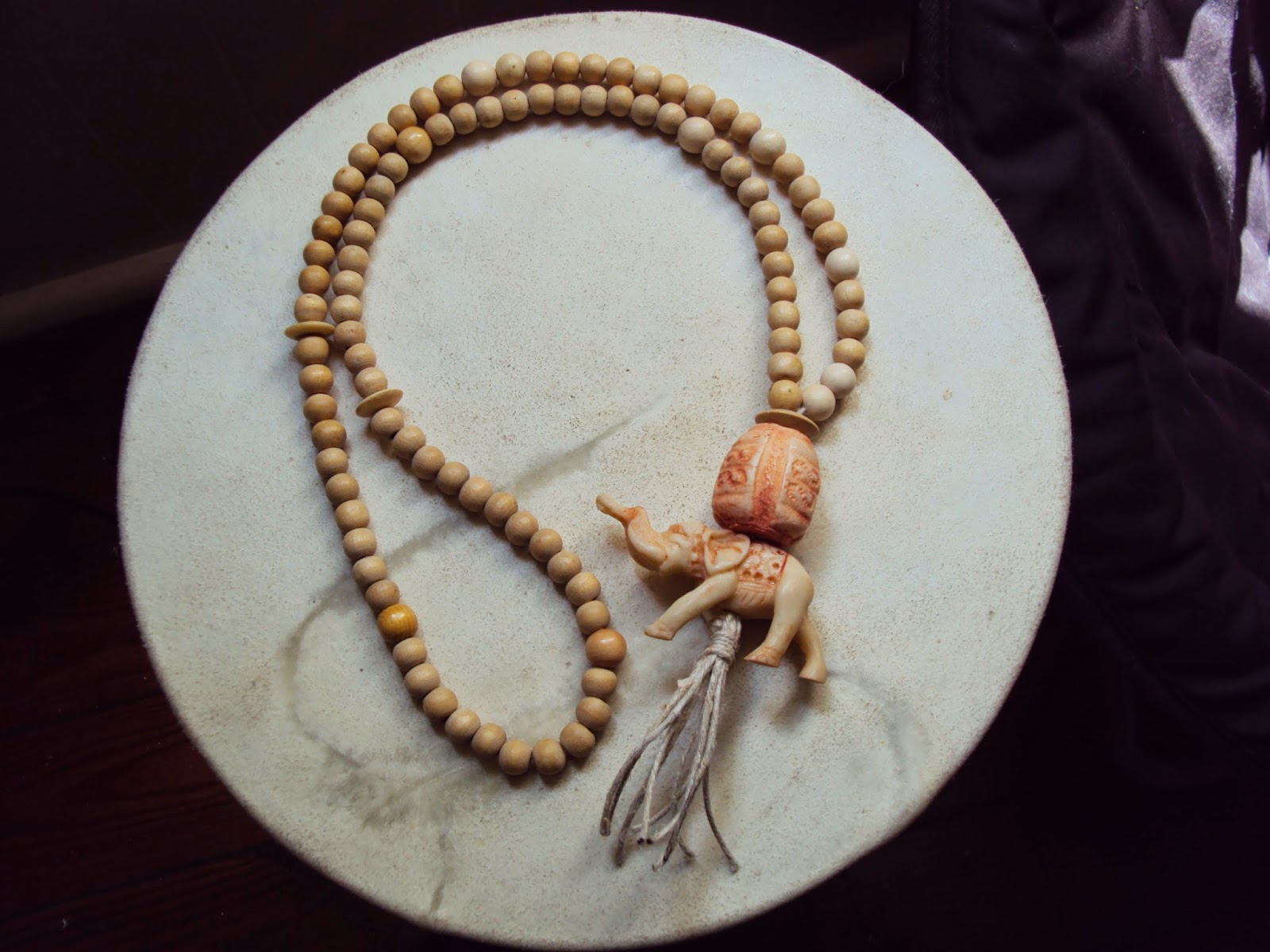
This was wood on hemp cord because my lord breaks things. Here I tied the (pul) end bead into the end with an added elephant because it is my lord's house and heraldry. So in this case the elephant knows the last name of Allah. He wears this one like a necklace.

These are stones that look like carved pits and the nisane are carved wood. Silk cord. After creating this I realized I probably shouldn't have added the pul bead at the end. This was created as a replacement for my lord who lost the red one after breaking it. He has since found the original red one and he is only allowed to hold this one in court.
The Beads were made out of all kinds of stones, wood, seeds, and bone etc. so, you can have a little fun with making them. I've also heard tale that there are some with little carved skulls. I should warn you, these are easy and fun to make and once you start researching prayer beads you might find yourself tangenting a lot.

These are Buddhist Mala prayer beads I made for a friend in the household
And this is a paternoster for another member of the household

 A few notes of interest:

Tassels at the ends of your strand are important to ward off evil.

The closest Jews had to prayer beads were knotted shawls.

My lord has indicated that the shorter beads are great for holding his sleeves out of the way while he uses the restroom.


Mental Blocks

I am going to post here about my struggles to explain a few things about my slew of posts. I am also posting this as a note to other people who may be experiencing similar issues.

I was encouraged well over a year ago to start a persona related blog. I started by putting up new things. I had this idea that everything had to be new and fresh or it wasn't worth posting it. I post all these things on my facebook why should I recant it in a blog post? Asking that out loud makes me realize how foolish that sounds. So I'm going to answer my question: not everyone is on social media sites. Other reasons include perceptions of social media being not academic; the fact that I am not friends with everyone on FB that could see my work; FB can quickly bury your awesome post amid a bunch of cat pictures and game requests; and quite frankly not that many people take the time to really read half of the stuff they see there because they are already over inundated with other media. Being this is a post about my own perceptions of things getting in my way I feel the need to point out that perception plays a large role in how you (and your work) are received.

In a recent conversation with a friend, she stepped outside of what she knows about me personally, and she said that she couldn't point to what it is that I "do" as an art (or focus) in the SCA. I've heard this in other ways before either to me or about others who weren't being "noticed." This time it sunk in. I have always known that my work is all over the place. I am a jack of all trades. I do leatherwork, brewing, cooking, research, sewing, Viking, Ottoman, casting, jewelry, embroidery, games....you get the idea. Since switching (or settling) to my Ottoman persona in 2006 almost everything I do is toward making a better body of knowledge and expertise in everything Ottoman. If I were to be known for something I want it to be that.

Example:  I learned naalbinding because I love Viking things (and used to research it almost exclusively) but also because I learned that it was very similar to Egyptian (mamluk) knitting that lead to modern "Turkish" picture knit socks. I love socks and was afraid of knitting because I thought my arthritis problems (which turned out to be more related to a caffeine allergy) would make two sticks challenging. Most naalbinding is done with a needle and your thumb. Learning the basic stitches would enable me to attempt a more persona appropriate stitch and also give me some base knowledge for further research so that I knew what I was looking at (or for) when doing museum research.

There is a lot of method in the madness of what I produce.

Another wall I've hit is that Ottoman (and a lot of middle eastern) was not overly researched/published until recently when it exploded. I admit to wanting to be a special snowflake and adding to a body of work that would help me stand out. Similarly I could improve on old ideas that had been presented and help combat "bad" middle eastern or over generalized attempts at ME garb. So now there are a lot of people posting and it seems like everytime I come up with something that seems new and shiny someone else had the same thought and posted near identical research a week before me. I'm not looking at my research as a competition but it seems redundant to me to post about something that someone in another kingdom has already done a ton of research on. Social media has made our Known World a lot smaller these days and so to "stand out" seems to be much harder.

Back to the perception blockade from the beginning of this rant: It doesn't matter if I made it 10 years ago or yesterday. The fact is that I may have a little piece of something that could help others. I might have done something wrong that could be fixed if only there was an audience in the know that has access to this information. Just because it isn't shiny and new to me or the people around me does not mean that it won't be revelatory to a whole new audience that would really love to see more of my work or those on a similar path just starting out. Maybe my way of explaining things is the way that person x needs to hear it for it to make sense, like when my friend re explained how people might not know what I am all about in terms of arts and sciences focus.The only way that I can prove there is a focus to my research is to put it in one place.

Last Thoughts:
I have really high standards for myself. I don't put things in competition unless they live up to a certain standard. I often don't display things because I didn't have time to do EPIC documentation and my perception is that at this "level" I need to. Sometimes I don't display things because I just learned about it in a class and my stuff isn't warranted presentation. I forget that part of being and artisan in the SCA is to educate and inspire. You never know who's going to see what you did and launch off of it. Maybe the expert at said art isn't showing of his stuff that day but because you are some young artist is going to (right place/time) have that long-missing-thing-in-their-life that gets them off the couch and doing art. So I am trying to battle my perception-dragons and push onward to the next battle.


Middle Eastern Games and the A&S 50 Challenge


In case you weren't aware, the 50th year anniversary of the SCA approaches fast! In 2016 there will be a grand celebration and a lot of arts going on. Someone put out a challenge to make 50 things on a theme and present it at the anniversary event. That sounds awesome to me! When I heard about this a few years ago I was knee deep in games research and classes (both learning and teaching) because I love games and I wanted to make a games manual from the middle eastern perspective. I decided then that I was going to generalize for the sake of the challenge to just medieval games, but when possible I am putting a middle eastern spin on them.


Game of the Camel modeled after Game of the Goose
I've completed around 30 games so far (if you count variations research) and have plans for so much more. At first I thought this might be limiting. Who says I have to just make games...the dice, the pieces, the boards, cards, research all counts given the theme I went under. So now my project has gotten way out of hand. One of my dream projects is to make woodcuts for printing based on a limited set of arabic playing cards found in a museum (info here). That would be near 50 things on its own, so maybe not for this challenge unless I want to make a single set scribally. 

As for the rest of my project, I have decided to ignore uber period presentation for practicality. When I sew or take commissions for things I tend to consider things like durability and portability more so than period methods. So most of my projects are period plausible or using the research and making it a functional piece that won't get ruined by dirty little hands or drunks. With that said, I made a lot of my games in one of two styles: Roll and tie, or bag. 

Bag style alquerque. The bag can played on and the pieces and rules can be slipped inside and tied shut when done.
Fabric boards have drawstrings all the way around that can be cinched and then tied around the outside with the pieces bag rolled inside.

The whole package can be tightly rolled to the size of a small kitten. Teek shows her approval.
Materials for the fabric boards have been canvas or poplin. I will sometimes line the back in cottons or linens (of course everything has been pre-washed to make sure that there are no accidents later). I've been using a combination of cotton embroidery and crochet threads to embroider the boards. I should point out at this point that I'm am still really new at embroidery. I took a class at a University event so that would understand basic embroidery before I started delving into Ottoman embroidery. 

Game of the Camel


If you are familiar with game of the goose (if not go here) you know that there are taverns and wells and geese. I really thought the game was fun but not very middle eastern appropriate so I made my own version. I kept the numbers and spacing of things but changed the special spaces. The function of geese in the game is to move people around the board...which seemed silly to me...and it was replaced with the most iconic method of desert travel, the camel.

Space 42 is where there is typically a maze (or a really interesting answer about life the universe and everything). I decided that a mirage would suit the theme best and also made an open desert marker on space 30 (where you are supposed to move back to).

In some versions of GOG there is a bridge to move players forward 6 spaces. I replaced it with a flying carpet, because why not? I also made a tassel on space 12 so I didn't have to write down the rules to keep with the game.

Alcohol is not permitted in most of Islam (I will be writing a very long post about this generalization later) so a tavern was right out. I replaced it with a coffee pot like you might see in a coffee house. Coffee houses had a similar function to taverns as they were a place to drink and be merry.

I replaced the jail with quicksand...and there is a poorly embroidered man flailing in a quicksand amoeba. 

Additionally I fringed the edges and added tassels at the corners. This was both a decorative effort and the tassels were heavy and helped hold the board down from wind intrusions. This was one of the first games I made and is also my favorite.

Atlanbaj

This is a super fun and challenging game of Turkish checkers. I took a class on this at Pennsic and have been trying to put together more and more research on it because it's not well represented on the internet or print sources and it should be. The game is largely played like checkers but huffing rules are enforced.

The game starts is on an 8x8 board and the players start with their back row empty. 

Because lots of "kinging" is highly possible I made wooden (bead) pieces with sticks glued into them to hold "crowns" on better.

Again this is a canvas board with embroidered lines. I'd gotten a lot better at chainstitch embroidery by this point.

Other considerations for my pieces having sticks was ease of use for little hands or big hands trying to grab small pieces. 

This is a roll and tie bag like GOC and can still be used to play draughts and checker variants. If you like checkers you should give this a try. When I took the class I was a little slow to catch on. I walked into class late because I'd just come off the field and thrown water at myself before running all the way from the serengeti to the games tent. My brain hadn't been re engaged yet and my partner whooped me. By the time we got to the second round I'd caught up with the game and promptly stomped him. He realized my strategy too late and was keen to point out that I was either a "shark" or thoroughly evil and and sneaky. 

Goals for the Challenge and Beyond

I'd like to make some hand carved or cast pieces for some games like shatranj and some bone dice. I am using glass beads for a lot of my games right now because it is what I have sitting around. I would also like to make an illuminated and hand bound game manual a la "alphonso x" of middle (and near) eastern games.  I will post more on specific middle eastern games as they come about. I have several games in progress towards my 50 that are not middle eastern related. 


Mini Talismanic Shirt

At Atlantian 12th Night there was a mystery ingredient scribal challenge. The event was Ottoman themed. I have really wanted to do more scribal things. I signed up. I couldn't resist. Once i've signed up for something I have a deadline which make it easier to ensure that progress is made.

The mystery challenges I'd seen in the past were fans and tangrams which seemed really out of the box and exciting. What did I get? I got paper. I was a little disappointed at first but after a week or two of thinking about it and a few synchronous research moments I had a wonderful idea: a Talismanic Shirt.

The paper was a thin fibrous paper made from mulberry bark.It looked and felt like fabric to me.
 The material and idea were married once I remembered reading that the talismanic shirts found in Persia and the Ottoman empire were made on fabric that was “paper thin.” The shirts were painted or inked by calligraphers with prayers or symbols of luck. After looking at several extant examples I noticed that in the original scale most of the writing was small and so my writing would have to be miniscule. I am not that good at calligraphy and I barely know any Arabic. I chose to do a larger scale design on a smaller scaled shirt.  I used some designs and prayers from the museum pieces and used other designs and prayers I have researched for other projects.


I believe this shirt belonged to Mehmed III. The overall cut of my project was based on this design largely because I have amazing pictures of it.


This shirt has larger designs of cypress trees and I wanted to use that.


 I had been doing side research on the talismanic shirts as a kind of dream project if my lord is knighted one day. Just based on the amount of time it took me to create the miniature version I have determined it will be a ton of work to make a full sized one. This was a kind of trial run for the bigger one. I have a lot to learn before I get there.

This one had such small mathematical charms I think I'd be reading it for a week and scribing it for years. Yikes! This style of shirt is most likely what I will use for my lord if ever I make one because he's a Berber and not an Ottoman.
I used my knowledge of Ottoman textile motifs, scribal and cultural design along with my very limited understanding of Arabic and its calligraphic nuances (seriously, they layered their words in an area to make signature calligraphed art) to make a miniature version. 

This is the finished piece with the sleeve and shoulder seams sewn.

Closeup of the sleeves

Closeup of the front before it was cut open

Shoulder seams
\

Back includes cypress, tulip and saz leaves.

I started out trying to use a dip pen. I did several trials on the scraps and had no problems. I was ten minutes into my finished pieces and ripped a small hole. I did not have spare paper so I decided to use modern calligraphy markers instead. I also had a small incident with a drooling cat and one of my pens not being indelible. I covered my mistakes as best I could and moved on. Lesson learned about the paper is that it would be very interesting for watercolor if you want it to spread around and make interesting blends.  I also used gold leaf paint. It was infuriating and flaked a lot.

Once I had completed the painting and undersewing I had to turn it wrong sides together and sew it. I used blue silk thread and as small a needle as I could for the thread. I was super careful. I then turned the whole thing right side out. There were a fair amount of wrinkles which, while it might be horrible for a scroll, is fantastic for that just worn fabric look. It was tedious trying to turn  the sleeves and I had to make more than one little snip under the arm to make it move without ripping. This also made the gold leaf almost completely rub off in parts and I touched it up after the fact.


I had originally wanted to make a doll to put it on and then ran out of time because there was a death in the family right after an emergency at work (sigh). Instead I put it on a mini easel and rigged a stick to hold the sleeves up. I intend to make the doll for another project involving the persona pentathlon.

Final piece is about 10x12 inches

All in all I had a fantastic time with the project. I wasn't able to go to the event but a friend took it for me and brought me back a prize! I have a lot to learn about scribal things (this was my second scribal thing ever). I have more to learn about Arabic.